
Market Strategy
World Cup Value Was Hyperlocal. Brand Strategy Should Be Too.
Why post-tournament spending, lodging, and foot-traffic data require a more precise approach than national exposure or host-city presence alone.
The 2026 FIFA World Cup delivered national-scale media audiences, approximately seven million match spectators, and more than nine million visits to official Fan Festivals. Its commercial effect, however, was not a uniform increase in activity across every host market.
The strongest results appeared in particular locations, categories, time periods, and consumer occasions.
Hotels increased rates substantially, yet occupancy declined against estimated normal performance in seven of the eleven U.S. host markets. Bars and pubs benefited more consistently than general dining. Soccer-oriented retail generated measurable traffic, while businesses without an immediate connection to the tournament could not assume that nearby crowds would become customers.
The tournament’s scale was national and international. Much of its commercial value was hyperlocal.
Brands, rights holders, host organizations, venues, and commercial partners should account for that distinction when planning future soccer programs in the United States.
A host city is not one commercial market
A major event is usually described through citywide attendance, tourism, media value, and economic-impact estimates. Those figures are useful for establishing scale, but they can obscure where activity actually occurs.
Supporters do not move through a host city evenly. They follow a series of destinations and routes:
Arrival
Airports, rail stations, transportation corridors, team hotels, and training locations.
Match journey
Stadium transportation routes, ticketed hospitality, merchandise locations, and venue-adjacent dining.
Public experience
Official Fan Festivals, supporter bars, cultural gathering places, and temporary brand experiences.
City activity
Tourist districts, retail centers, restaurants, and neighborhoods associated with national communities.
Each location presents a different audience, purpose, dwell time, spending pattern, and level of commercial access.
A brand can therefore have a presence in the correct city but the wrong part of the city. It can operate during the correct tournament but miss the moments when its audience is making decisions.
A host-city designation should be treated as the beginning of market planning, not as sufficient evidence that an activation location will work.
Hotel performance exposed the difference between demand and pricing
The lodging results provide one of the clearest examples.
HVS analyzed the eleven U.S. host markets by comparing actual World Cup-period hotel performance with a counterfactual estimate of how each market would have performed without the tournament. The study estimated that the World Cup generated $680 million in incremental room revenue.
The revenue was distributed unevenly. New York accounted for approximately $339.2 million, roughly half of the total. Los Angeles generated an estimated $77.2 million, Boston $69.3 million, Dallas $60.8 million, and Miami $34.2 million.
Match count alone did not explain the difference. New York and Atlanta each hosted eight matches, yet HVS estimated New York’s incremental room revenue per match at $42.4 million, compared with $1.2 million in Atlanta.
Occupancy also declined against the estimated baseline in seven host markets. Average daily rates increased in all eleven, allowing every market to record higher revenue per available room despite the occupancy weakness.
The result does not mean that the tournament failed to generate demand. It shows that commercial performance depended on existing market occupancy, available room supply, venue geography, transportation, pricing, team assignments, traveling supporter bases, and the displacement of ordinary leisure and group business.
For corporate hospitality programs, this has an immediate implication. A room in a host market is not a standard unit whose cost and value can be forecast from the tournament schedule alone.
Organizations need market-specific assumptions covering hotel location, match assignments, minimum stays, transportation, alternative accommodations, existing leisure demand, room-block terms, surrounding business options, and the possibility that aggressive pricing will discourage attendance.
Hospitality procurement and activation planning should be connected. A less expensive hotel that creates difficult transportation, limited evening programming, or poor customer access may reduce the value of the larger experience.
Sources: HVS U.S. host-market hotel analysis · Colliers World Cup Impact Report
Supporter occasions created the most dependable traffic
Location mattered, but so did the reason people had for visiting.
Placer.ai found that nearly every U.S. host market outperformed the national trend in bar and pub traffic during the tournament. Los Angeles and the San Francisco Bay Area recorded year-over-year increases of more than 15%, while Houston produced double-digit growth.
The pattern makes commercial sense. Bars and pubs offered an obvious role in the supporter journey: communal viewing, food and beverage service, social interaction, and an atmosphere that could be accessed without a match ticket.
General proximity to the World Cup did not provide the same advantage to every business. An establishment needed to serve a relevant occasion.
This principle extends beyond hospitality.
Chipotle’s opening-day promotion offered a second example. Customers wearing soccer jerseys after 3 p.m. could receive a buy-one-get-one entrée. According to Placer.ai, nationwide visits on June 11 were 55.5% above the company’s 2026 daily average. During the promotion window, visits were 88% above the year-to-date average for those hours.
The execution was simple, but its commercial architecture was specific. It connected a recognizable supporter behavior, wearing a jersey, with a clear benefit during a defined period.
The brand did not depend on supporters encountering a general World Cup message. It gave them a reason to perform an action.
For brands without official rights, this is particularly relevant. A useful consumer occasion can sometimes create more measurable participation than a broad thematic campaign, provided the execution respects applicable intellectual-property and ambush-marketing rules.
Sources: Placer.ai host-market bar traffic · Placer.ai Chipotle promotion analysis
Soccer relevance helped convert attention into retail visits
Adidas produced another measurable result.
Placer.ai reported that visits to Adidas stores increased 44.7% year over year during the week of June 15, the first full week of tournament play. Visits remained more than 20% above the prior year during the weeks of June 22 and June 29.
Several factors likely contributed. Adidas supplied the official match ball, outfitted multiple national teams, operated tournament activations, and already held established credibility in soccer. The company also created physical destinations where consumers could connect tournament attention with merchandise and participation.
Colliers highlighted the opening of Adidas’ 9,000-square-foot soccer-focused flagship at American Dream in East Rutherford, near the final venue. The store combined retail with interactive experiences, community programming, and appearances.
The important point is not simply that an official sponsor generated traffic. The brand connected rights, product relevance, team associations, physical retail, local programming, tournament geography, and consumer action.
Visibility introduced the relationship. Product, place, and programming gave people a reason to enter the store.
Brands should measure those stages separately. Media exposure, activation visits, retail traffic, customer acquisition, sales, and continuing participation describe different parts of the result.
Sources: Placer.ai Adidas store-traffic analysis · Colliers retail and activation analysis
Fan Festivals became commercial centers of their own
The official Fan Festival program confirmed that the tournament extended beyond stadium attendance.
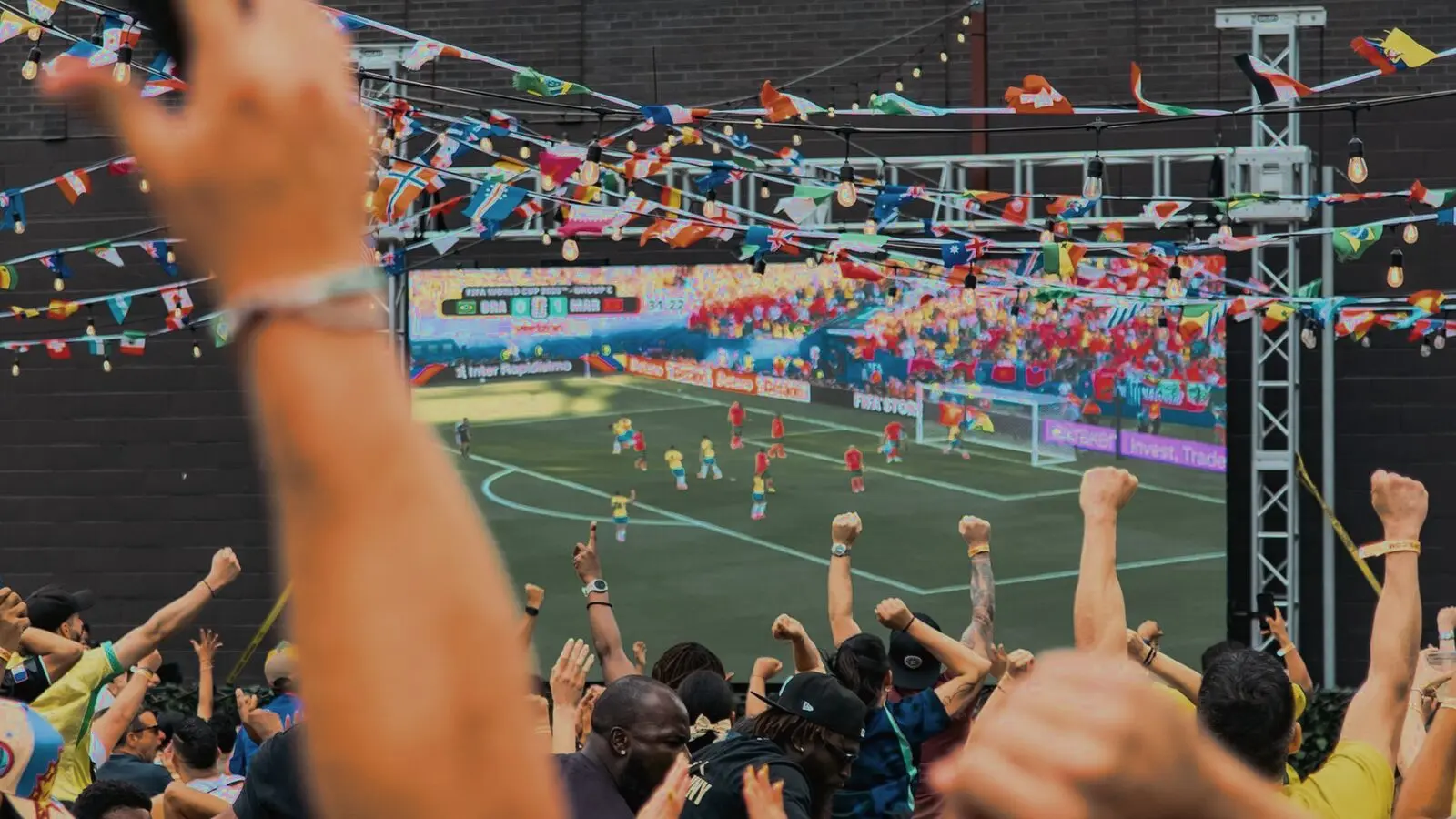
FIFA reported 9,017,000 visits across 13 Fan Festival locations during 348 combined operating days. The sites presented all 104 matches, more than 873 live performances, 113 commercial-partner activation spaces, food and beverage operations, merchandise stores, and local cultural programming.
The festivals also generated 811 million digital video views from FIFA’s tournament content.
These figures establish Fan Festivals as more than secondary viewing areas for supporters without tickets. They operated as separate media, entertainment, retail, and sponsorship environments.
For brands, that creates a different commercial brief from stadium activation.
A stadium audience is concentrated around a ticketed match and a controlled venue journey. A festival audience may include residents, tourists, families, casual fans, committed supporters, and people primarily interested in entertainment or community participation. Visit frequency, dwell time, entry barriers, and spending behavior can also differ.
Activation design should reflect those conditions. A festival program may need a useful reason to enter, repeated-participation capacity, flexible engagement formats, family and multilingual delivery, a clear data exchange, and content intended for audiences beyond the physical site.
Treating a fan festival as outdoor exhibition space leaves much of its value unused.
Sources: FIFA Fan Festival results
Commercial geography can extend beyond official host markets
The World Cup’s operating footprint also reached communities that did not host matches.
National teams established base camps in locations including Irvine, San Diego, Austin, Nashville, Charlotte, Columbus, Chattanooga, Greensboro, Palm Beach Gardens, and Santa Barbara. These locations accommodated teams, federation personnel, media, sponsors, and associated visitors for longer periods than a single match window.
Other cities attracted supporters moving between host markets. This creates a broader definition of a commercially relevant soccer market.
A city may matter because it hosts matches, a national-team base camp, supporters traveling between matches, a large diaspora connected with a participating country, a recognized viewing district, sponsor operations, a regional transportation hub, or a community organization capable of continuing the relationship.
Visa’s World Cup spending analysis provides additional evidence. After controlling for state-level spending conditions and gasoline trends, Visa found a statistically significant June spending lift in U.S. counties with large foreign-born populations connected to participating nations.
Commercial planning should therefore examine supporter identity and behavior, not only the official event map.
Sources: Visa World Cup consumer-spending analysis · Colliers base-camp market analysis
National campaigns need local operating plans
A national platform remains valuable. It can establish consistent positioning, creative standards, media partnerships, talent relationships, and measurement systems.
The mistake is assuming that national consistency requires identical execution.
A more effective structure begins with one commercial strategy and a portfolio of local market plans. Each priority market should define:
1. The audience
Identify which supporter communities, customers, business prospects, or employees are commercially important.
2. The relevant moments
Determine whether people are attending, watching publicly, entertaining clients, shopping, traveling, or participating from home.
3. The commercial geography
Map the stadium zones, districts, retail locations, hotels, routes, and community venues that matter.
4. The brand’s role
Define what the organization makes easier, better, more accessible, or more useful.
5. The operating model
Assign control of location, staffing, permits, security, data, production, hospitality, and customer follow-up.
6. The conversion path
Connect participation with registration, purchase, membership, a business conversation, or continuing engagement.
7. The post-event value
Identify which relationships, customer data, programs, content, or local partnerships will remain.
This approach does not require activating everywhere. It provides a disciplined basis for deciding where a brand should invest deeply, where a lighter presence is appropriate, and where participation is unlikely to produce sufficient value.
Measurement should follow the same level of precision
Tournament-scale totals can make a program appear successful while hiding large differences between markets and executions.
Measurement should distinguish national media reach from local participation, host-market activity from venue-adjacent activity, international visitors from domestic audiences, match days from non-match days, event-generated demand from displaced ordinary demand, first visits from repeat participation, and gross transactions from incremental transactions.
It should also separate activation traffic from qualified customer acquisition, hospitality attendance from business follow-up, and temporary attention from retained audience relationships.
Baseline selection is particularly important.
Comparing a match day with an average day, the same weekday, the prior year, or an estimated event-free scenario can produce different conclusions. The method should be selected before the program begins and reported clearly.
Brands should also include cost-to-serve. A high-traffic location can become commercially weak if premium rent, temporary construction, staffing, transportation, security, and customer-acquisition costs absorb the resulting value.
Sources: Reuters pre-tournament travel and lodging analysis · HVS counterfactual methodology
The next U.S. soccer opportunity requires greater precision
The World Cup confirmed the scale of soccer’s American commercial audience. Post-tournament evidence now provides a more useful second conclusion.
Scale does not distribute value automatically.
The organizations that benefited most created a direct relationship between the tournament, a place, an occasion, and a consumer or business action. They understood where supporters would gather, what those supporters were trying to do, and how the brand could participate in that moment.
Future soccer strategies should be built with the same level of precision.
National reach can establish awareness. Rights can create access. A host market can provide opportunity. Commercial value is produced when those assets are connected with the right audience, location, timing, experience, and next action.
SGN VIEW
National reach can establish awareness. Rights can create access. A host market can provide opportunity. Commercial value is produced when those assets are connected with the right audience, location, timing, experience, and next action.